11 Sep 2026
How to Choose the Right Veneer Furniture Board
Learn More >


In modern furniture manufacturing, weight reduction is no longer just a design preference. It has become a structural requirement driven by transportation cost, installation efficiency, and modular interior systems.
The evolution of furniture board lightweight materials is fundamentally changing how panels are engineered, especially in large-scale applications such as cabinet systems, modular wall panels, office furniture structures, and prefabricated interior environments.
Unlike traditional particleboard or MDF systems that prioritize density over handling efficiency, lightweight furniture boards aim to balance three critical parameters: mechanical strength, density reduction, and long-term dimensional stability.
In industrial production, achieving this balance requires precise control over material structure, adhesive chemistry, and pressing technology.
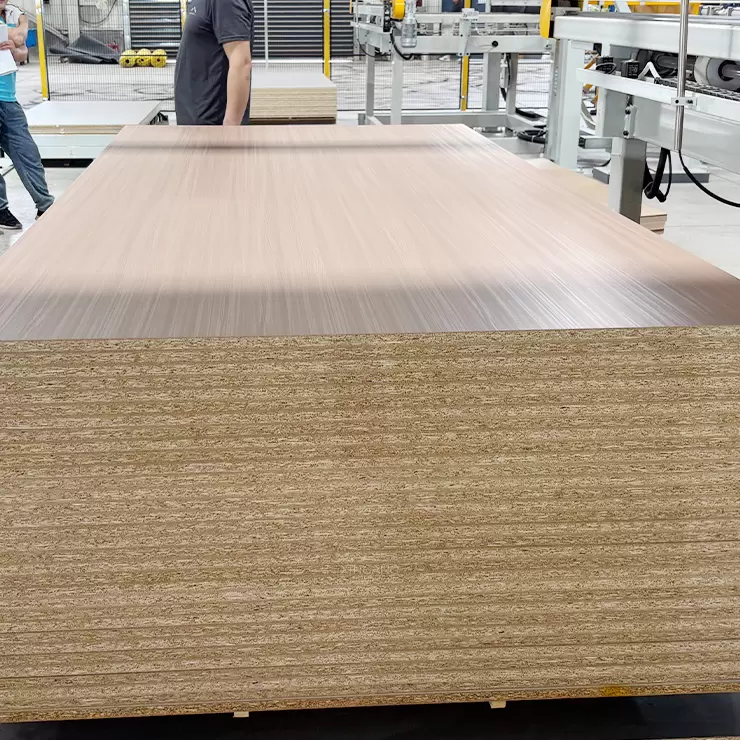
The most important performance indicator of any furniture board lightweight system is density.
Conventional MDF typically operates in the range of 650–850 kg/m³, while optimized lightweight boards aim to reduce this to approximately 450–650 kg/m³ depending on application scenarios.
This reduction is not simply about removing material mass. It is achieved through:
Shandong Xingang Group’s biomimetic adhesive technology plays a key role in stabilizing this structure while maintaining internal bonding strength, ensuring that density reduction does not compromise mechanical integrity.
Reducing board weight introduces a fundamental engineering challenge: maintaining bending strength and internal bond strength.
Key performance parameters typically include:
To maintain these values in lightweight structures, resin distribution must be extremely uniform. Uneven adhesive penetration leads to weak internal zones, which become failure points under load.
The use of formaldehyde-free biomimetic adhesives allows more controlled bonding behavior, improving consistency across large-scale production batches.
Furniture board lightweight systems are widely used in global environments with varying humidity levels.
Typical industrial requirements include:
Lightweight boards are inherently more sensitive to moisture-induced deformation due to reduced mass and altered internal structure. Therefore, stabilization treatments become essential.
Advanced production systems incorporate:
These processes ensure dimensional stability without adding excessive weight back into the structure.
One of the most significant innovations in modern furniture board lightweight manufacturing is the transition toward zero-emission adhesive systems.
Traditional urea-formaldehyde resins, while cost-effective, introduce long-term indoor air quality concerns.
In contrast, biomimetic adhesives developed by Shandong Xingang Group enable:
This makes lightweight boards suitable for sensitive applications such as residential interiors, healthcare environments, and educational facilities.
Beyond compliance, this also improves material lifecycle sustainability and global export compatibility.
Furniture board lightweight materials are not used in a single uniform application; instead, they must adapt to multiple structural contexts:
Cabinet systems require high screw-holding strength
Wall panels require dimensional flatness over large surfaces
Modular furniture requires low weight per unit volume
Transport furniture systems require impact resistance under movement
Each of these scenarios places different stress profiles on the material.
A well-designed lightweight board must therefore behave as a multi-functional structural substrate rather than a single-purpose panel.
Large-scale production of furniture board lightweight materials requires strict process control across multiple stages:
Even minor deviations in temperature or pressure distribution can result in density inconsistency, leading to warping or reduced mechanical strength.
Industrial manufacturers rely heavily on real-time monitoring systems to maintain batch consistency, especially when producing export-grade panels.
Furniture board lightweight systems represent more than a material substitution. They reflect a shift in how interior structures are designed—moving from mass-based stability to engineered performance stability.
By combining controlled density reduction, formaldehyde-free adhesive systems, and high-precision manufacturing processes, modern lightweight boards achieve a balance between usability, environmental safety, and structural integrity.
In this evolution, biomimetic adhesive technologies such as those developed by Shandong Xingang Group are enabling a new generation of green, high-performance furniture materials.