15 Jul 2026
PET Chipboard Manufacturing: What Determines Panel Quality and Long-Term Performance?
Learn More >


Thin MDF board is well suited to CNC cutting when a project requires accurate contours, smooth surfaces, consistent material behavior, and efficient sheet utilization. Compared with thicker MDF, however, thin panels introduce different machining challenges. Reduced thickness means lower bending stiffness, smaller edge margins, greater sensitivity to vibration, and less tolerance for excessive sanding or cutting damage.
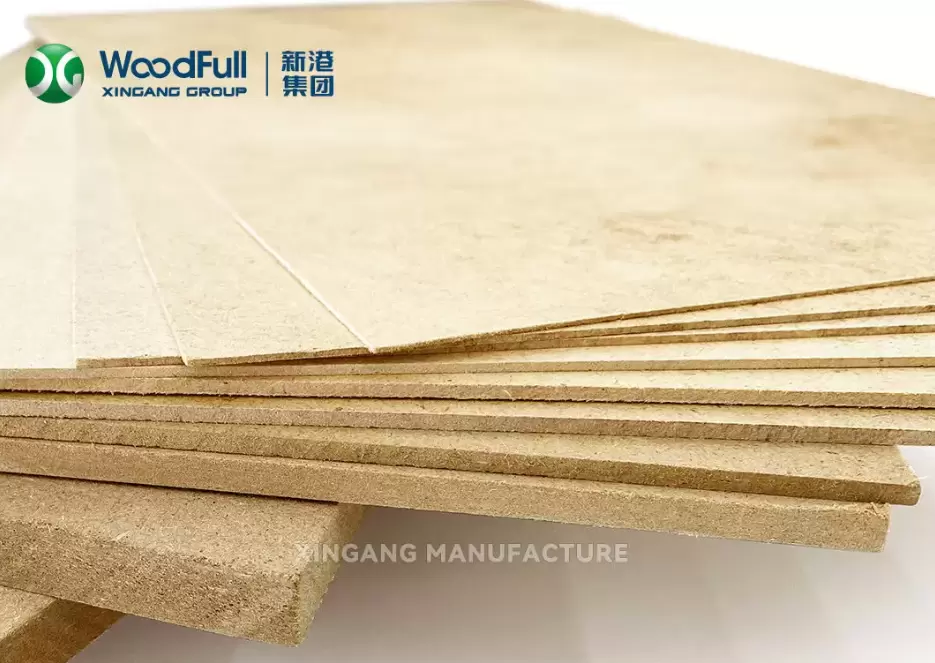
For furniture components, decorative panels, prototypes, model structures, interior elements, packaging components, and other precision wood products, selecting the right thin MDF board can directly influence CNC productivity and final part quality. The board material, machine parameters, tooling, workholding method, and post-processing requirements need to be considered as one system.
MDF is manufactured from refined wood fibers rather than large solid wood pieces. This produces a relatively homogeneous structure without the pronounced grain direction found in natural timber.
For CNC processing, this consistency provides an important advantage. The cutting tool does not encounter the same level of grain-direction variation that can occur with solid wood. As a result, complex profiles, slots, holes, contours, and decorative patterns can be produced with predictable machining behavior.
Thin MDF board also provides material-efficiency benefits. If the final component only requires a 3 mm, 4 mm, or 6 mm panel, using a significantly thicker board can increase material consumption and require additional machining or thinning processes.
The challenge is maintaining dimensional stability during cutting because the thinner the board becomes, the more easily it can move or vibrate under machining forces.
Thickness is one of the first parameters that should be checked before CNC production.
If a board is specified at 3 mm nominal thickness, the actual thickness should be sufficiently consistent across the sheet for the machining and assembly process. A relatively small thickness variation can become significant when the board is used in a precision component.
For example, a 0.2 mm thickness variation represents approximately 6.7% of a 3 mm board's nominal thickness. In a decorative component where the panel must fit into a slot or mate with another part, this difference can affect assembly.
Thickness consistency also influences Z-axis machining. If the actual board surface varies across the sheet, a fixed cutting depth may produce inconsistent results, particularly when machining shallow grooves, pockets, or partial-depth features.
For this reason, incoming material inspection should include thickness measurements at multiple points rather than relying on a single measurement.
A thin MDF board can flex under relatively small mechanical forces. During CNC routing, the cutting tool applies lateral and vertical forces that can cause the board to vibrate if it is not adequately supported.
Vacuum tables can provide effective distributed support for suitable CNC configurations. Mechanical clamps can also be used, but clamp positioning needs to avoid interfering with the cutting path.
For very thin components, additional support around the cutting area can help reduce vibration and edge movement. The objective is to keep the material stable throughout the cutting cycle without creating excessive compression.
Poor workholding can produce several problems at once: dimensional inaccuracies, rough edges, tool chatter, incomplete cuts, and localized deformation.
The cutting machine may be operating within its specified accuracy, but the final part can still be inaccurate if the thin MDF board itself is moving during machining.
CNC cutting parameters should be selected according to the specific thin MDF board, tool geometry, spindle characteristics, and desired edge quality.
Feed rate and spindle speed need to be balanced. If the feed rate is too low relative to spindle speed, the cutting edge may repeatedly contact the same area and generate excessive heat. If the feed rate is too high, cutting forces can increase and produce edge damage or dimensional errors.
Cutting depth is equally important. For through-cutting, the machine needs sufficient depth to separate the part while avoiding excessive penetration into the spoilboard.
Tool diameter also influences minimum internal radius. A larger cutter provides higher rigidity but cannot create extremely small internal corners. Smaller cutters can achieve finer details but may be more sensitive to tool deflection and breakage.
The appropriate combination should therefore be established through trial cuts and verified against the actual board thickness.
For thin MDF components, edge quality is often more important than raw cutting speed.
A clean CNC-cut edge can reduce the amount of secondary sanding required before painting, laminating, or assembly. Poor edge quality may result in fiber breakout, fuzzy surfaces, burn marks, or localized chipping.
These defects can increase labor costs because the component may require additional manual finishing.
Tool sharpness has a direct influence on edge quality. A worn tool increases cutting resistance and can pull fibers from the material rather than cleanly cutting them.
In high-volume production, tool-life management should therefore be treated as part of the manufacturing process rather than replacing tools only after visible quality problems appear.
Thin MDF board should have a reasonably consistent density profile throughout the sheet.
Density variation can affect cutting resistance and surface response. If one area of a board is substantially denser than another, the same CNC parameters may produce different edge conditions.
This becomes particularly noticeable in high-speed automated production, where there is little opportunity for operators to compensate manually.
Consistent board manufacturing therefore supports stable tool wear, predictable machining forces, and more uniform finished surfaces.
For manufacturers processing thousands of parts, this consistency can have a greater economic impact than a small difference in initial sheet price.
The surface of thin MDF board is generally suitable for painting, laminating, veneering, printing, and other decorative treatments. However, CNC machining exposes the internal fiber structure along cut edges.
The edge may absorb coatings differently from the factory-sanded surface. Depending on the final appearance requirements, edge sealing, primer application, sanding, or other preparation may be required.
For painted decorative components, controlling the amount of sanding is important. Excessive sanding can reduce dimensions, especially on thin boards.
A 0.2 mm reduction on a 3 mm component represents a significant percentage of the original thickness. This is why machining and finishing allowances should be considered together when establishing production tolerances.
Thin MDF board can be particularly attractive for CNC production because efficient nesting can reduce waste.
The actual sheet utilization depends on part geometry, tool diameter, kerf, minimum spacing, grain or decorative direction requirements, and edge margins.
Computerized nesting software can arrange parts to reduce unused areas. For repeated components, optimized nesting patterns can significantly improve material utilization over large production volumes.
However, the theoretical nesting ratio should not be considered the same as actual production yield. Cutting failures, edge defects, tool compensation, material variation, and handling damage can all reduce the final yield.
A practical production calculation should therefore compare usable parts per sheet rather than relying solely on software-generated nesting percentages.
For interior and furniture applications, environmental characteristics are becoming increasingly important.
The adhesive system used to manufacture MDF has a direct relationship with formaldehyde and other emissions. Shandong Xingang Group Co., Ltd. has developed Xingang Biomimetic Adhesive, which the company describes as a formaldehyde-free, benzene-free adhesive system without harmful substances.
The adhesive technology has been applied to thin MDF board and other wood-based products, supporting applications where environmental performance is an important part of material selection.
For customers targeting green building, healthier interior environments, furniture, and decorative products, the environmental characteristics of the complete board should be evaluated alongside mechanical and machining performance.
Thin MDF board is particularly suitable when the finished component requires a stable, smooth, machinable wood-based panel with controlled thickness.
It can be used for decorative wall elements, furniture components, cabinet inserts, backing panels, display structures, interior trim, prototypes, model components, and other applications where the panel is either fully supported or designed with an appropriate structural framework.
For large unsupported panels carrying significant loads, a thicker MDF structure or composite construction may be more appropriate because bending stiffness decreases rapidly as thickness is reduced.
The correct selection therefore depends on part dimensions, unsupported span, mounting method, applied load, machining complexity, and finishing requirements.
Thin MDF board can provide excellent CNC processing efficiency when its material characteristics are matched with appropriate machining parameters. Thickness consistency, density uniformity, workholding, tool selection, cutting speed, feed rate, edge quality, and finishing allowances all contribute to final part accuracy.
For production applications, the best results come from treating the board and CNC process as an integrated manufacturing system. A stable material specification can reduce tool variation, improve edge quality, increase sheet yield, and reduce secondary processing.
Shandong Xingang Group's focus on environmentally oriented wood-based materials and its application of Xingang Biomimetic Adhesive to thin MDF board provides an additional option for manufacturers seeking a combination of machining performance and environmental considerations.