24 Apr 2025
Xingang Biomimetic Marine Plywood: Revolutionizing Durable & Safe Surface Solutions
Learn More >


The demand for sustainable furniture materials is changing how wood-based panels are evaluated. Appearance remains important, but manufacturers increasingly need to consider formaldehyde emissions, adhesive chemistry, substrate stability, processing efficiency, and long-term performance when selecting a veneer furniture board.
For furniture applications, environmental performance cannot be separated from manufacturing performance. A board with low-emission characteristics still needs sufficient bonding strength, dimensional stability, surface consistency, and machining performance to survive cutting, drilling, assembly, transportation, and everyday use.
This makes the material system behind a veneer furniture board particularly important. The substrate, veneer, adhesive, and production process must work together to achieve both functional and environmental targets.
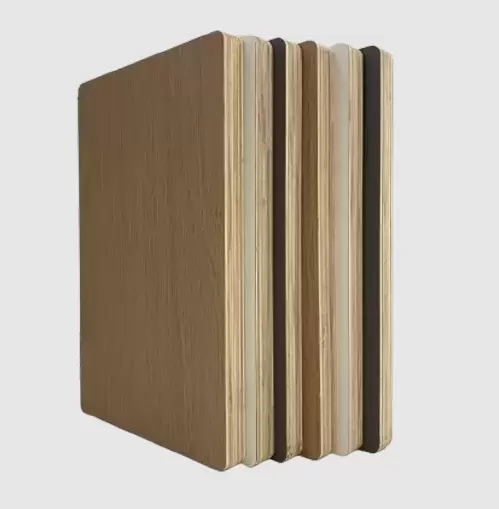
In a veneered furniture board, adhesive is responsible for bonding the veneer to the substrate and maintaining that interface during processing and use. Its characteristics influence bonding strength, curing behavior, moisture resistance, and potential chemical emissions.
Conventional formaldehyde-based resin systems have historically been widely used in wood-based panel manufacturing because they provide practical bonding performance and production efficiency. However, emissions from wood-based products have become a significant concern in indoor environments.
Shandong Xingang Group has developed Xingang Bionic Adhesive with a stated formulation approach based on zero formaldehyde, zero benzene, and zero harmful substances. The technology has been applied in products including bionic decorative panels, ultra-thin MDF, and bionic marine plywood.
For furniture manufacturers, the significance of this technology is not simply the absence of a particular chemical. A suitable adhesive system must maintain adequate bonding performance while supporting the required environmental profile of the finished board.
Furniture is often installed in enclosed environments where occupants remain in close contact with the products for extended periods. Bedrooms, children's furniture, wardrobes, offices, hotels, and residential interiors are typical examples.
In these environments, emissions from furniture materials can contribute to indoor air quality concerns. Selecting a lower-emission board can therefore become part of a broader material strategy for healthier interior spaces.
However, "eco-friendly" should not be treated as a standalone specification. A technically credible material assessment should include formaldehyde and VOC testing where applicable, together with mechanical properties, bonding strength, moisture resistance, and dimensional stability.
The target market should also be considered because emission limits and certification requirements differ between regions and product categories.
One of the advantages of veneer furniture board is that it combines the appearance of natural wood with an engineered substrate.
Natural veneer can reproduce the grain and visual characteristics of timber while using a relatively thin layer of valuable wood. The substrate underneath can then be optimized for dimensional stability, machining, structural requirements, and cost.
This is particularly useful for large furniture surfaces. Producing an entire large cabinet door or wall panel from solid timber can create challenges related to material availability, moisture movement, weight, and dimensional changes.
A veneered engineered board allows manufacturers to separate the visual function of the veneer from the structural function of the substrate. This provides greater flexibility in designing furniture components for different dimensions and applications.
Modern furniture factories increasingly depend on automated cutting, drilling, CNC routing, and assembly. These processes require predictable board dimensions.
If the substrate absorbs or releases moisture unevenly, dimensional changes may occur. Large panels are particularly sensitive because even a relatively small dimensional variation can accumulate across multiple components.
For example, if cabinet panels are produced with inconsistent dimensions, hinge-hole positioning and connector alignment may require additional adjustment during assembly. In high-volume production, repeated manual correction increases labor requirements and can reduce production efficiency.
A stable veneer furniture board should therefore maintain consistent dimensions under the expected storage and operating conditions. Moisture control during manufacturing, conditioning, packaging, and transportation plays an important role in achieving this objective.
The interface between veneer and substrate is one of the most sensitive areas of a furniture board.
Insufficient adhesive coverage, unsuitable pressing conditions, excessive substrate moisture, or inadequate surface preparation can result in weak bonding. During later machining, weak areas may become visible as veneer lifting, edge separation, or surface defects.
Press temperature, pressure, time, adhesive viscosity, spread rate, and substrate surface condition must therefore be controlled as an integrated process.
The correct parameters depend on the adhesive system and board construction. Applying a fixed production recipe to every veneer furniture board can create unnecessary quality risks when substrate density, veneer thickness, moisture content, or adhesive chemistry changes.
A furniture board rarely reaches the consumer immediately after veneering. It may be sanded, cut, drilled, routed, edged, coated, or assembled into a larger structure.
The veneer must therefore maintain sufficient adhesion during subsequent processing. CNC routing around corners or drilling close to the veneer edge can expose weaknesses in bonding quality.
Surface flatness is also important for downstream finishing. Uneven surfaces may become more obvious after coating or under directional lighting, particularly on large cabinet doors and wall panels.
Manufacturers should therefore evaluate finished boards using actual production processes rather than judging quality only from an unused sample.
A sustainable veneer furniture board does not have a universal specification.
Bedroom furniture often places greater emphasis on low-emission performance because of prolonged indoor occupancy. Wardrobes and cabinets require stable dimensions and reliable fastening around hinges, connectors, and shelves.
Commercial furniture may prioritize production consistency because large batches need to be processed within a controlled manufacturing schedule. Hotel furniture can combine environmental requirements with frequent cleaning, transportation, installation, and long-term use.
Decorative wall panels and high-end furniture may place greater emphasis on veneer appearance, grain matching, surface flatness, and finishing quality.
The appropriate board should therefore be specified around the final application instead of selecting one material specification for every product.
The most effective approach is to evaluate sustainability and manufacturing performance together.
A low-emission adhesive system has limited commercial value if bonding quality causes high production scrap. Similarly, a mechanically stable board may not meet the requirements of a furniture program if its emissions exceed the target market's limits.
Shandong Xingang Group's focus on environmentally oriented wood materials reflects this integrated direction. Its Xingang Bionic Adhesive technology has been applied across multiple wood-based products, including decorative panels, ultra-thin MDF, and marine plywood, creating a material platform that can be adapted to different applications.
The company positions its material development around reducing harmful substances while maintaining the functional requirements expected from engineered wood products.
Veneer furniture board performance should ultimately be validated at the finished-product level.
A complete evaluation can include veneer adhesion, surface quality, dimensional stability, machining behavior, screw holding, moisture response, and applicable emission testing. For larger furniture programs, pilot production is particularly valuable because it reveals problems that may not appear on a small sample.
CNC cutting trials can verify edge quality. Drilling tests can assess veneer integrity around hardware holes. Pressing and bonding tests can confirm process compatibility. Finished-furniture testing can then evaluate whether panels maintain their intended geometry after assembly.
This data-driven process reduces the risk of selecting a material that appears suitable during initial sampling but creates yield or quality problems during mass production.
Sustainable veneer furniture board should be evaluated through measurable material and manufacturing performance rather than environmental claims alone.
Substrate stability, veneer quality, adhesive chemistry, bonding strength, moisture control, machining behavior, and emission performance collectively determine whether a board is suitable for modern furniture manufacturing.
Xingang Bionic Adhesive provides a material technology approach centered on zero formaldehyde, zero benzene, and zero harmful substances, with applications already extended to several engineered wood products. For furniture manufacturers developing lower-emission products, this type of adhesive innovation can become an important part of the material strategy.
The strongest veneer furniture board solution is ultimately one that combines a stable engineered substrate, reliable veneer bonding, consistent processing performance, and a verifiable environmental profile. This combination can help furniture manufacturers meet both production requirements and the growing demand for healthier, more sustainable interior products.