24 Feb 2026
Kickoff For A New Year | Moving Forward With Global Vision
Learn More >


When developing furniture with a veneered surface, choosing between an MDF-based veneer furniture board and a plywood-based structure can significantly influence machining, dimensional stability, fastening performance, weight, and final product cost.
Neither substrate is universally superior. The better choice depends on furniture dimensions, loading conditions, machining requirements, moisture exposure, hardware installation, and the required surface finish. Understanding these differences before production can prevent problems such as edge damage, warping, weak screw retention, or inconsistent veneer bonding.
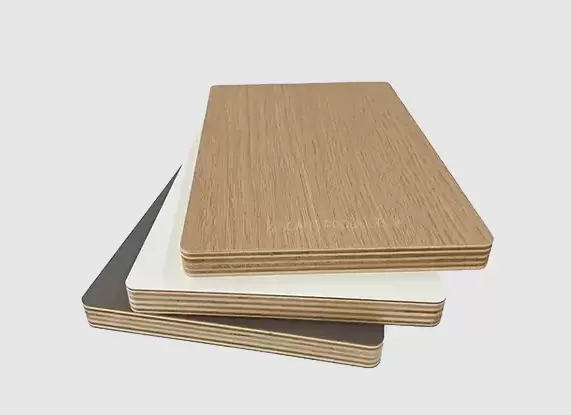
MDF is manufactured from refined wood fibers combined with adhesive and compressed into a relatively homogeneous panel. Its uniform internal structure provides predictable machining characteristics and a smooth surface that works well with veneer.
Plywood is manufactured by bonding multiple wood veneer layers with adjacent grain directions. This cross-laminated structure provides useful dimensional stability and mechanical strength, particularly when the panel needs to resist loads in different directions.
For furniture components requiring extensive CNC routing, profiling, or detailed machining, MDF can provide advantages because its uniform structure reduces the variability associated with natural wood layers.
For larger structural panels or applications requiring stronger mechanical performance, plywood may be more appropriate depending on the grade and construction.
Veneer requires a stable and sufficiently smooth substrate. Any irregularity beneath the veneer can become visible after pressing and finishing.
MDF provides a fine, homogeneous surface that can support consistent veneer application. This is useful for cabinet doors, furniture panels, decorative surfaces, and components requiring machining around edges.
Plywood has a layered construction, and its surface quality depends heavily on the outer veneer grade. If the surface contains irregularities, additional preparation may be required before applying the decorative veneer.
The final specification should therefore consider the intended veneer thickness. Thinner veneer places greater demands on substrate smoothness because surface imperfections are more likely to transfer through the decorative layer.
Modern furniture production often uses CNC routers to produce holes, grooves, pockets, profiles, and connector openings.
MDF's homogeneous fiber structure generally provides predictable cutting behavior and is particularly suitable for routing and profiling. It can be processed into complex furniture components without exposing alternating structural layers.
Plywood can also be CNC machined effectively, but the cutting result depends on the wood species, veneer construction, adhesive system, and number of layers. Cutting through multiple layers can produce different edge characteristics from those of MDF.
For furniture components with extensive edge profiling, MDF may therefore offer process advantages. For components where mechanical strength is more important than complex profiling, plywood can provide a different performance balance.
Furniture assembly frequently depends on screws, cam connectors, hinges, drawer slides, and other hardware.
The substrate must provide adequate fastening performance around these connection points. MDF has relatively uniform density, but screw-holding capacity varies with density, board thickness, screw geometry, and installation method.
Plywood benefits from its laminated structure and can provide strong fastening performance, particularly when screw placement is properly designed relative to the veneer layers.
However, neither material should be evaluated only through a generic "strength" specification. Actual hardware type, screw diameter, edge distance, insertion depth, and loading direction should be considered.
For mass-produced furniture, representative fastening tests using the intended hardware can provide more useful information than comparing substrate names alone.
Large wardrobe doors, cabinet sides, wall panels, and furniture partitions can be sensitive to dimensional movement.
MDF and plywood respond differently to environmental humidity because of their different structures. Plywood's cross-laminated construction can provide good dimensional stability, while MDF offers a relatively uniform material structure.
Actual performance depends on board density, construction, moisture content, edge sealing, environmental conditions, and manufacturing quality.
For furniture intended for humid areas, substrate selection should therefore be accompanied by moisture-resistance requirements. A standard interior-grade panel may not provide the same performance as a panel specifically designed for higher humidity exposure.
The adhesive layer must create a reliable interface between the substrate and decorative veneer.
This is particularly important when manufacturers are developing lower-emission furniture. Shandong Xingang Group has developed Xingang Bionic Adhesive, which the company describes as containing zero formaldehyde, zero benzene, and zero harmful substances.
The adhesive technology has been applied to several wood-based products, including Xingang bionic decorative panels, ultra-thin MDF, and bionic marine plywood. For veneer furniture board development, this provides an example of how adhesive chemistry can be considered as part of the board's overall environmental and performance profile.
Regardless of substrate selection, the adhesive system must be validated for bonding strength, curing behavior, moisture conditions, veneer type, and pressing parameters.
Material price per square meter is only one part of the actual cost of a veneer furniture board.
A cheaper substrate can become more expensive if it creates higher machining scrap, requires additional surface preparation, produces more veneer defects, or increases assembly adjustment.
MDF may provide manufacturing efficiency for components requiring extensive routing and a highly uniform surface. Plywood may offer better value where structural performance reduces the need for additional reinforcement or where lighter construction is beneficial.
Transportation should also be considered. Board density and thickness directly influence finished-product weight, which affects logistics and installation.
The correct economic comparison should therefore include material cost, machining time, yield, hardware performance, finishing requirements, packaging, transportation, and expected service life.
For smooth cabinet doors with complex CNC profiles, an MDF-based veneer furniture board can be a practical choice because of its uniform structure and surface quality.
For furniture requiring higher structural stiffness, large panels, or strong fastening performance, plywood may be more suitable depending on the grade and construction.
For premium decorative furniture, veneer appearance and surface consistency may become the primary considerations, while the substrate is selected to support the required finishing process.
For humid environments, neither MDF nor plywood should be selected solely by material category. The specific moisture-resistant grade, adhesive system, edge treatment, and environmental exposure must be evaluated together.
Before committing to large-scale production, the selected veneer furniture board should be tested under the actual manufacturing process.
Representative tests can include CNC cutting, drilling, edge routing, veneer adhesion, screw holding, dimensional stability, surface finishing, and environmental exposure.
This approach is especially valuable when switching from one substrate to another. A change from MDF to plywood, or vice versa, may require modifications to cutting parameters, drilling settings, adhesive application, pressing conditions, or finishing processes.
The objective is not to determine whether MDF or plywood is "better" in general. The objective is to identify which construction provides the required performance at the lowest total production risk.
Shandong Xingang Group Co., Ltd. focuses on environmentally oriented wood materials and has developed material technologies for multiple engineered wood applications.
Its Xingang Bionic Adhesive has been applied in bionic decorative panels, ultra-thin MDF, and bionic marine plywood. This product development approach allows different substrate structures to be considered together with adhesive technology rather than treating the adhesive as an isolated production consumable.
For veneer furniture board applications, such integration can help manufacturers evaluate environmental performance, bonding behavior, surface quality, and production requirements as one material system.
The choice between MDF and plywood for veneer furniture board should be based on the actual furniture construction rather than a simple material preference.
MDF can offer advantages in surface uniformity, CNC machining, profiling, and decorative applications, while plywood can provide useful structural characteristics, dimensional stability, and fastening performance. The final decision should also account for board density, thickness, moisture exposure, veneer construction, adhesive chemistry, hardware requirements, and production methods.
For manufacturers developing sustainable furniture, adhesive technology adds another important dimension to substrate selection. Xingang Bionic Adhesive's stated zero-formaldehyde, zero-benzene, and zero-harmful-substance approach provides an option for manufacturers seeking to develop lower-emission engineered wood products.
A technically sound veneer furniture board is ultimately the result of matching substrate, veneer, adhesive, manufacturing process, and application conditions. Evaluating these factors together provides a more reliable path toward consistent furniture quality, efficient production, and a stronger environmental profile.