22 Apr 2026
Surface Engineering in Melamine Plywood: How Material Science Improves Durability and Aesthetic Performance
Learn More >


Birch plywood is a popular material for CNC furniture production, cabinet components, shelving, display systems, interior fittings, and precision-cut panels. Its cross-laminated veneer structure provides useful mechanical properties, while its natural surface and exposed layered edges offer design flexibility. However, achieving consistent CNC machining results requires more than selecting a suitable panel thickness. Veneer quality, internal bonding, dimensional tolerance, moisture content, and cutting parameters all influence the final component.
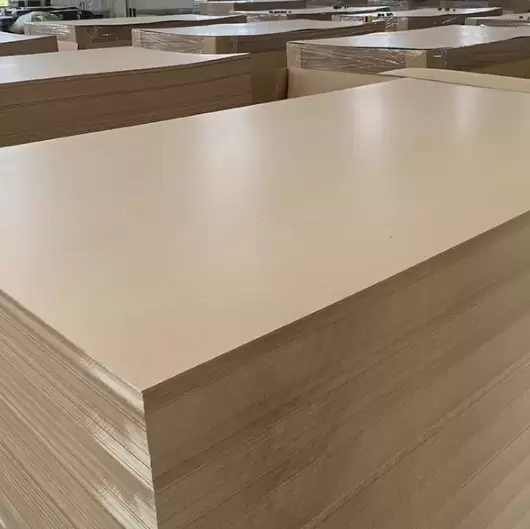
For manufacturers processing large quantities of panels, small variations in raw material can create significant production problems. Inconsistent thickness may affect tool settings and component dimensions. Internal voids can produce defects along routed edges. Poor bonding may cause veneer separation during cutting, while excessive moisture variation can lead to dimensional changes after machining. Selecting birch plywood based on its machining characteristics helps improve yield and reduce downstream rework.
Birch plywood consists of multiple layers of birch veneer bonded together, typically with adjacent grain directions arranged at right angles. This structure provides a balance of stiffness and strength in different directions, making the material suitable for flat furniture components and shaped parts.
Compared with many solid wood materials, birch plywood generally offers more predictable panel dimensions and less directional movement. This is valuable in CNC production, where components are cut according to programmed dimensions and assembled with relatively tight tolerances.
Its layered edge can also be used as a visual design element. In contemporary furniture, shelving, retail displays, and architectural interiors, exposed plywood edges are sometimes retained rather than covered with edge banding. This makes veneer consistency and internal construction particularly important because machining can reveal the quality of every layer.
Thickness is one of the most important specifications for CNC-machined birch plywood. Common furniture panel thicknesses include 9 mm, 12 mm, 15 mm, 18 mm, and 21 mm, although the available range depends on the manufacturer and product specification.
The correct thickness depends on component dimensions, loading conditions, support spacing, hardware design, and machining requirements. An 18 mm panel may be suitable for many cabinet sides and shelves, while thinner panels may be used for drawer bottoms, back panels, and lightweight interior components. These are common application examples rather than universal design rules; actual suitability must be confirmed through structural and assembly evaluation.
Thickness tolerance matters because CNC programs are often developed around nominal material dimensions. If actual thickness varies significantly between sheets, groove depths, pocket dimensions, edge treatments, and hardware installation may become inconsistent. For components that require accurate joints, even relatively small deviations can affect assembly quality.
A reliable specification should define nominal thickness, acceptable tolerance, measurement method, and sampling frequency. Measurements should be taken at multiple points on each panel because thickness variation may occur across the surface. Calibration of measuring equipment and consistent inspection procedures help ensure that incoming material meets the production requirement.
The internal structure of birch plywood directly affects CNC cutting performance. Well-bonded veneer layers help the panel remain intact during routing, drilling, and edge machining. In contrast, weak bonding can lead to local separation, rough edges, and visible defects.
Internal voids are another concern. When a CNC router cuts through an area containing a gap between veneer layers, the edge may show cavities or loose veneer sections. These defects can complicate edge finishing and may be unacceptable in furniture with exposed plywood edges.
Veneer quality should therefore be assessed not only by the visible face but also by the consistency of the core. Relevant factors include veneer thickness, overlap control, gap distribution, core alignment, and adhesive coverage. For high-volume CNC production, a consistent core structure can be more valuable than a visually attractive face veneer alone.
The adhesive system determines how effectively veneer layers remain bonded during manufacturing and service. Bonding performance is influenced by adhesive formulation, spread rate, veneer moisture content, assembly time, pressing temperature, pressure, and curing conditions.
Insufficient adhesive application may create weak bonding, while unsuitable pressing conditions can result in incomplete curing or other quality defects. Excessive or uneven adhesive application may also affect panel quality and processing characteristics.
For CNC applications, bonding strength should be appropriate for the intended panel use and the relevant product standard. Internal bond or bond-quality testing can help evaluate the integrity of the panel structure. Depending on the application and market requirements, additional testing may be needed for moisture resistance or emissions.
Shandong Xingang Group Co., Ltd. has developed Xingang biomimetic adhesive as part of its focus on environmentally oriented wood-based materials. According to the company, the adhesive is designed without formaldehyde, benzene, or other harmful substances and has been applied in products such as biomimetic decorative boards, ultra-thin density boards, and biomimetic marine plywood. When considering this technology for birch plywood, manufacturers should verify the exact panel formulation, bonding performance, and applicable test results for the product being supplied.
Even high-quality birch plywood can produce poor machining results if cutting parameters are unsuitable. Tool geometry, cutting speed, feed rate, spindle speed, cutting depth, and tool condition all influence edge quality and tool life.
A sharp carbide router bit is commonly used for plywood machining. Tool selection should account for panel thickness, veneer structure, cutting direction, and the required edge finish. Compression-style bits may be useful where both upper and lower surface quality must be maintained, while other tool geometries may be more appropriate for specific cutting operations.
Feed rate and spindle speed should be adjusted together. Excessive feed may cause tearing, vibration, or rough edges, while unsuitable spindle speed can increase heat generation and accelerate tool wear. A worn cutting edge may produce veneer splintering and inconsistent dimensions even when the CNC program remains unchanged.
Rather than relying on generic parameter recommendations, production settings should be validated using the actual panel, tool, and machine configuration. A short test run can establish suitable settings before a full production batch begins.
Birch plywood is a wood-based product, so its moisture content responds to the surrounding environment. Differences between panel moisture and workshop conditions can cause dimensional changes, warping, or inconsistent machining results.
Panels should be stored on a flat, adequately supported surface in a dry and ventilated area. Direct contact with floors, standing water, and sudden humidity changes should be avoided. When panels are transferred from storage into a controlled production environment, allowing sufficient acclimatization can help reduce dimensional variation.
Moisture content should be checked when the application requires tighter dimensional control or when panels are being used in environments with substantial humidity changes. Consistent storage practices are especially important for large-volume CNC operations because even minor material movement can affect the fit of multiple components.
A CNC-ready panel specification should cover more than appearance. Incoming inspection can include panel dimensions, thickness tolerance, squareness, flatness, surface defects, edge condition, and moisture content. For critical applications, bonding strength and other mechanical properties should also be verified against agreed requirements.
A practical qualification process should include trial machining. Representative panels can be cut using the intended CNC program and evaluated for dimensional accuracy, edge quality, veneer separation, drilling performance, and assembly fit. If the final product includes exposed edges, those edges should be inspected under the same lighting and finishing conditions used for production approval.
This approach helps identify material-related issues before they affect an entire batch. It also creates a clearer basis for communication between the panel supplier and the furniture manufacturer.
Consistent CNC production depends on stable raw material quality and clear technical specifications. Birch plywood should be evaluated according to thickness accuracy, core integrity, bonding performance, machining behavior, moisture stability, and environmental requirements.
Shandong Xingang Group Co., Ltd. is committed to developing environmentally oriented wood-based materials and working with global partners to support healthier and more sustainable interior environments. By combining material innovation with application-based evaluation, manufacturers can identify panel solutions that better match their machining processes and finished-product requirements.
Ultimately, the value of birch plywood in CNC manufacturing comes from predictable performance across the entire production cycle. Consistent panels help reduce tool adjustments, machining defects, assembly problems, and material waste. Defining measurable quality requirements and validating panels through actual machining trials provides a practical foundation for long-term supply reliability.