12 Nov 2025
Sustainable Particle Board Production: Turning Wood Waste into High-Value Products
Learn More >


Particle board is one of the most widely used engineered wood products in furniture manufacturing and interior construction. From wardrobes and cabinets to office desks and wall panels, its popularity comes from its balance of affordability and performance. However, not all particle boards are created equal. The manufacturing process directly determines a board’s strength, durability, environmental performance, and overall cost.
Understanding how particle board is manufactured helps buyers, designers, and builders make smarter material decisions.
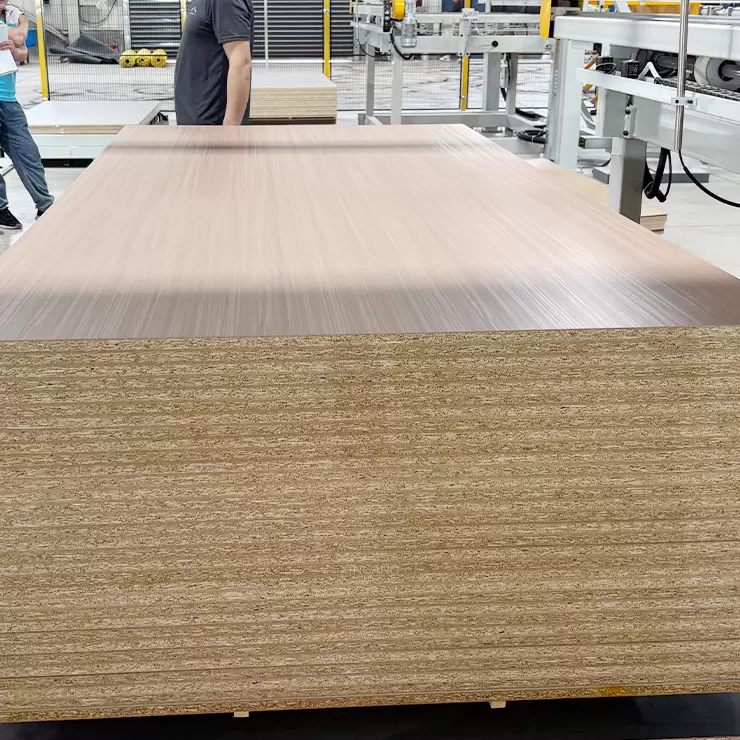
The strength of particle board begins with the quality of its raw materials. Manufacturers typically use wood chips, sawdust, and wood shavings. The type of wood, particle size consistency, and cleanliness significantly affect:
Internal bonding strength
Surface smoothness
Density stability
Uniform, high-quality wood particles create better interlocking structures during pressing, resulting in stronger boards with improved load-bearing capacity.
Companies such as Shandong Xingang Group Co., Ltd. focus on controlled raw material sourcing and advanced processing to ensure consistent particle structure and superior board performance.
Adhesives play a critical role in determining both mechanical strength and environmental impact. Traditional particle boards often rely on urea-formaldehyde resins, which can affect indoor air quality.
Innovative adhesive technologies are reshaping the industry. Shandong Xingang Group has developed Xingang Biomimetic Adhesive, featuring:
0 formaldehyde
0 benzene
0 harmful substances
This eco-friendly adhesive has been successfully applied at scale in biomimetic decorative boards, ultra-thin MDF, and biomimetic marine plywood. The result is panels that are not only environmentally friendly but also antibacterial, antiviral, and high-performance.
Advanced adhesive bonding improves:
Internal bond strength
Moisture resistance
Long-term structural stability
At the same time, healthier adhesive systems enhance product value without compromising safety.
After blending wood particles with adhesive, the mat is formed and hot-pressed under high temperature and pressure. This stage determines:
Board density
Thickness uniformity
Surface hardness
Higher and more uniform density typically increases bending strength and impact resistance. However, it can also raise production costs due to higher material input and energy consumption.
Precision pressing technology ensures optimal balance — maximizing structural strength while maintaining cost efficiency.
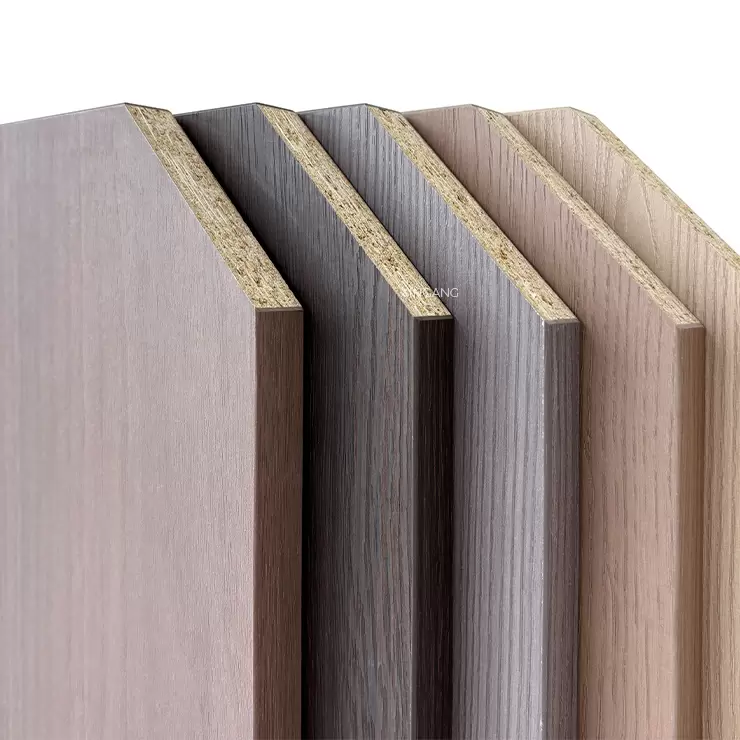
Modern particle boards are often manufactured with a three-layer structure:
Fine particles on the surface for smooth finishing
Coarser particles in the core for strength and cost control
This layered design improves screw-holding capacity and surface quality while optimizing raw material use. Efficient structural design reduces unnecessary material consumption, directly lowering manufacturing costs without sacrificing durability.
Durability depends heavily on moisture control during production. Proper drying of wood particles and correct resin ratios reduce swelling and deformation over time.
High-quality particle boards demonstrate:
Low thickness swelling
Strong dimensional stability
Resistance to warping and cracking
With environmentally advanced adhesive systems and strict quality control, manufacturers like Shandong Xingang Group enhance both durability and sustainability.
The cost of particle board is influenced by:
Raw material quality
Adhesive type
Energy consumption during hot pressing
Environmental compliance standards
Quality control processes
Boards made with eco-friendly, zero-emission adhesives may have slightly higher production costs initially. However, they offer long-term value through improved health performance, regulatory compliance, and enhanced durability.
As global markets demand greener building materials, sustainable production methods are becoming not just an ethical choice but a competitive advantage.
The particle board industry is evolving beyond simple cost efficiency. Today’s consumers and manufacturers demand materials that combine:
Mechanical strength
Long service life
Environmental responsibility
Health-conscious design
Shandong Xingang Group continues to invest in environmentally friendly new materials and advanced adhesive technologies. By collaborating with global partners, the company is working to build a green home ecosystem that promotes healthier, more sustainable living spaces for people worldwide.
The manufacture of particle board directly impacts its strength, durability, and cost. From raw material preparation and adhesive innovation to pressing technology and structural design, every production step influences performance outcomes.
As sustainability and health standards rise, manufacturers that prioritize advanced material science and eco-friendly innovation are leading the industry forward. By combining high mechanical performance with zero-harmful-substance adhesives, companies like Shandong Xingang Group demonstrate that particle board can be both strong and sustainable, supporting a healthier future for modern construction and furniture manufacturing.