01 Apr 2026
Sustainable Melamine Particle Board: Low-Emission Materials for Green Building and Furniture Manufacturing
Learn More >


Adhesive selection is one of the most important technical decisions in a particle board manufacturing plant because it directly affects bonding strength, production speed, moisture resistance, formaldehyde emissions, and finished-board consistency. The adhesive must perform reliably under specific manufacturing conditions while meeting the requirements of the intended application, whether the final product is used in furniture, cabinetry, interior decoration, flooring substrates, or other engineered wood applications.
A suitable adhesive is not necessarily the one with the lowest purchase price or highest laboratory bonding strength. Its real value depends on how effectively it integrates with wood particle characteristics, blending equipment, mat formation, hot pressing, and environmental performance requirements. As the industry moves toward greener building materials, manufacturers are also evaluating innovative adhesive technologies that can reduce harmful emissions without sacrificing industrial productivity.
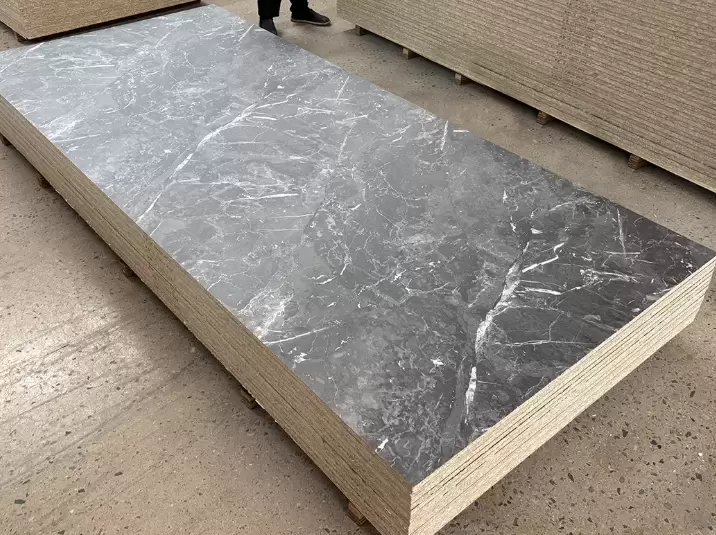
Different adhesive systems offer different combinations of cost, curing behavior, mechanical performance, and environmental characteristics.
Urea-Formaldehyde (UF) Resin
UF resin is widely used in interior-grade particle board manufacturing because of its relatively low cost, fast curing characteristics, and compatibility with established hot-pressing processes. It provides effective bonding under controlled manufacturing conditions and is suitable for many furniture and interior applications.
Its main limitation is formaldehyde-related emissions and comparatively limited moisture resistance. Manufacturers using UF resin must carefully manage resin formulation, application rate, curing conditions, and finished-board emission performance.
Melamine-Urea-Formaldehyde (MUF) Resin
MUF resin incorporates melamine to improve certain performance characteristics, particularly moisture resistance and bonding durability compared with conventional UF formulations. It may be selected for applications requiring improved resistance to humidity or more demanding service conditions.
However, the formulation and cost are generally more complex than conventional UF resin. Its actual emission and performance characteristics depend on the specific resin formulation and manufacturing conditions.
Phenol-Formaldehyde (PF) Resin
PF resin is commonly associated with applications requiring stronger moisture resistance and durability. It is particularly relevant to certain exterior-grade wood-based panels and demanding structural applications.
Its darker cured appearance, higher processing temperatures in some applications, and cost considerations may limit its suitability for decorative interior particle board products.
Formaldehyde-Free Adhesive Technologies
Formaldehyde-free adhesives represent an alternative approach to conventional formaldehyde-based resin systems. Rather than simply reducing formaldehyde content, these technologies use different bonding mechanisms to connect wood particles.
Their potential advantages include improved environmental positioning and the ability to develop products for applications with strict indoor air quality expectations. However, manufacturers must verify curing behavior, bonding performance, production compatibility, moisture resistance, and long-term stability before large-scale implementation.
The first consideration should be the mechanical performance required by the finished board. Internal bond strength measures the resistance of the board to internal separation perpendicular to its surface. It is particularly important because particle board relies on effective bonding throughout its thickness.
Bending strength and modulus of elasticity are also important for boards used in furniture components, shelving, and structural applications. These properties are influenced by particle geometry, density distribution, adhesive coverage, and pressing conditions, not adhesive chemistry alone.
Moisture resistance should be evaluated according to the intended application. Standard interior furniture boards may have different requirements from panels exposed to humid environments. Thickness swelling after water exposure is a useful indicator when comparing formulations, although the appropriate acceptance limits depend on the applicable product standard.
Curing behavior is another decisive factor. Adhesives must develop sufficient bonding strength within the available hot-press cycle. A formulation requiring significantly longer curing time may reduce production throughput or require changes to the existing press schedule.
Environmental performance must also be considered. Manufacturers targeting international markets should identify the applicable formaldehyde emission requirements and testing methods before selecting a bonding system. Product claims should be based on recognized testing rather than adhesive supplier descriptions alone.
An adhesive that performs well in laboratory testing may not automatically deliver equivalent results in a full-scale particle board manufacturing plant. Industrial production introduces additional variables, including particle moisture, wood species, particle size distribution, resin viscosity, spraying efficiency, and heat transfer.
For example, fine surface particles have a larger total surface area than coarse core particles. Consequently, adhesive distribution requirements may differ between the two layers. A blending system designed for conventional resin may also require adjustments when handling a new adhesive with different viscosity or spraying characteristics.
Hot-press compatibility deserves particular attention. The adhesive must cure effectively under the available temperature, pressure, and pressing-time conditions. Manufacturers should evaluate core temperature development, board thickness, initial mat moisture, and density profile when introducing a different formulation.
A structured trial should begin with laboratory bonding tests, followed by pilot-scale production and full-scale validation. During these stages, manufacturers should record adhesive consumption, pressing cycle time, internal bond strength, bending performance, thickness swelling, and emission results. This provides a measurable basis for determining whether the new adhesive can meet both technical and commercial requirements.
Evaluation Factor | UF Resin | MUF Resin | PF Resin | Formaldehyde-Free Adhesives |
|---|---|---|---|---|
Typical application | Interior particle board | Improved moisture-resistant panels | Demanding moisture-resistant applications | Environmentally oriented panels |
Relative material cost | Generally low | Generally higher than UF | Formulation-dependent | Technology-dependent |
Curing behavior | Generally fast | Formulation-dependent | Formulation-dependent | Depends on chemistry |
Moisture resistance | Generally limited | Improved over conventional UF in suitable formulations | Generally high | Requires product-specific validation |
Formaldehyde considerations | Formaldehyde-based | Formaldehyde-based | Formaldehyde-based | Depends on verified formulation |
Process compatibility | Established | Established in suitable systems | Application-dependent | Requires process validation |
This comparison is intended as a general industry reference. Actual performance varies with formulation, resin dosage, particle characteristics, and manufacturing conditions.
The development of environmentally oriented wood materials is creating new opportunities for particle board manufacturers. Instead of treating emission reduction as an isolated compliance requirement, manufacturers can use adhesive innovation to differentiate finished products and support healthier indoor environments.
Shandong Xingang Group Co., Ltd. has developed Xingang Biomimetic Adhesive, positioned as a zero-formaldehyde, zero-benzene, and zero-harmful-substance adhesive technology. The company has successfully achieved large-scale application of this technology in biomimetic decorative boards, ultra-thin density boards, and biomimetic marine plywood.
This development demonstrates the industrial potential of alternative bonding technologies beyond conventional formaldehyde-based resin systems. Its application in different engineered wood products also reflects the importance of adapting adhesive formulations to specific material structures and production requirements.
For particle board manufacturers, the key consideration is whether an alternative adhesive can deliver consistent bonding performance at commercial production scale. This requires evaluating mechanical properties, water resistance, curing efficiency, material compatibility, and independently verified environmental characteristics.
The purchase price of adhesive is only one component of manufacturing cost. A more meaningful evaluation considers total adhesive consumption per cubic meter of finished board, press cycle time, energy requirements, production yield, defect rates, and quality testing costs.
For instance, reducing resin consumption by 5% may appear attractive, but if internal bond strength decreases and rejected board volume increases, the overall economic result may be negative. Similarly, a higher-priced adhesive may provide better commercial value if it enables a higher-value product category or meets stricter environmental specifications.
Manufacturers should therefore evaluate adhesive systems based on the cost of producing one cubic meter of qualified finished board. This approach connects material selection directly with production economics and long-term product competitiveness.
Choosing the right adhesive for a particle board manufacturing plant requires a comprehensive assessment of mechanical performance, curing characteristics, moisture resistance, environmental requirements, process compatibility, and total production cost. UF, MUF, and PF resins remain relevant to different industrial applications, while formaldehyde-free technologies are creating new possibilities for environmentally oriented engineered wood products.
Shandong Xingang Group's Xingang Biomimetic Adhesive represents an innovative direction in this transition, with established applications in several wood-based panel categories. By combining adhesive innovation with systematic production validation, manufacturers can improve product quality, address changing environmental expectations, and strengthen the long-term competitiveness of their particle board operations.