22 Sep 2026
Oak Block Furniture Board: CNC Machining and Furniture Applications
Learn More >


Choosing a veneer furniture board requires more than selecting an attractive wood surface. In actual furniture manufacturing, the board must provide stable dimensions, reliable bonding, consistent surface quality, sufficient screw-holding performance, and predictable machining behavior. When the same material is used across cabinets, wardrobes, wall panels, tables, or customized furniture, variations in moisture, density, bonding quality, or surface flatness can quickly affect production yield and finished-product quality.
For manufacturers sourcing veneer furniture board, the technical evaluation should therefore cover the complete board structure: substrate, veneer, adhesive system, pressing process, moisture control, surface treatment, and subsequent machining. The right combination can improve processing consistency while also reducing issues such as delamination, warping, edge cracking, and surface defects.
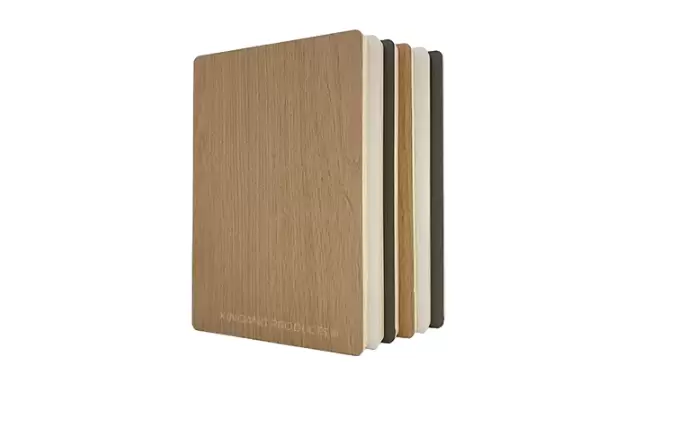
A veneer furniture board generally consists of a wood-based substrate combined with a natural or decorative veneer layer. The substrate provides most of the board's structural properties, while the veneer determines much of its appearance and surface characteristics.
Common substrate options include plywood, MDF, particleboard, and other engineered wood panels. Each has different density, dimensional stability, screw-holding capability, machining behavior, and cost characteristics.
MDF, for example, provides a relatively uniform structure that is suitable for routing, drilling, profiling, and painted or veneered surfaces. Plywood generally offers a layered structure with good mechanical strength and dimensional stability, making it useful for applications where the board needs to tolerate repeated loading or fastening.
The selection should therefore be based on the final furniture construction rather than veneer appearance alone. A wardrobe door, kitchen cabinet side panel, and load-bearing furniture component may require completely different substrate characteristics even when they use the same decorative veneer.
The veneer layer is not simply a decorative coating. Thickness, grain structure, moisture condition, and bonding quality can all influence the finished panel.
Thin veneer can reduce material consumption and provide an efficient way to create a natural wood appearance, but it requires greater control over the substrate surface and pressing process. Thicker veneer can provide greater sanding and refinishing allowance, which may be useful for furniture products requiring additional surface treatment.
Veneer selection also affects visual consistency. Natural wood contains variations in grain direction, color, knots, and texture. For larger furniture surfaces, veneer matching and panel-to-panel consistency become important because differences can remain highly visible after assembly.
A controlled production process should therefore consider veneer moisture content, grain orientation, joint quality, and surface preparation before pressing.
Adhesive selection is one of the most important technical factors in furniture board production because it affects bonding strength, durability, and emissions.
Traditional wood-based panel production may involve adhesives containing formaldehyde-based resin systems. For furniture intended for bedrooms, children's rooms, offices, or other enclosed environments, formaldehyde emissions have become an increasingly important consideration.
Shandong Xingang Group Co., Ltd. has developed a proprietary Xingang Bionic Adhesive technology positioned around a formaldehyde-free and benzene-free material approach. According to the company's product information, the adhesive is designed without formaldehyde, benzene, and other harmful substances and has been applied at scale in Xingang bionic decorative panels, ultra-thin MDF, and bionic marine plywood.
For veneer furniture board, this type of adhesive technology can be particularly relevant when the finished furniture is positioned around low-emission, environmentally responsible, or healthier indoor applications.
However, adhesive selection should still be evaluated through relevant testing and certification requirements for the target market. Bond strength, moisture resistance, curing conditions, press temperature, and production cycle must all be validated together.
Furniture manufacturers increasingly rely on CNC routers, automatic drilling machines, edge-banding systems, and other high-precision equipment. Board stability therefore has a direct relationship with processing efficiency.
If a veneer furniture board experiences excessive dimensional change after leaving the factory, hole positions and component dimensions can deviate from the intended design. Warping can also create difficulties during automated feeding and clamping.
Moisture content is a major factor. Wood-based materials respond to changes in environmental humidity, and uneven moisture distribution can contribute to dimensional instability.
For this reason, board conditioning and moisture control should be considered part of quality management. A stable production process should maintain consistent moisture conditions from substrate preparation through veneer pressing, storage, and packaging.
A flat board is important not only for appearance but also for downstream assembly.
Cabinet panels and furniture doors often need to align precisely with hinges, drawer slides, connectors, and adjacent components. If the board has excessive deformation, the finished furniture may require additional adjustment during installation.
Surface flatness also affects veneering quality. Uneven substrate surfaces can transfer defects through the veneer layer, creating visible depressions or raised areas under certain lighting conditions.
This makes sanding and substrate preparation important process stages. The substrate should provide a sufficiently uniform surface before veneer application so that pressing pressure can be distributed consistently.
The final board may undergo cutting, drilling, routing, edge processing, sanding, and assembly. A material that performs well during laboratory testing may still create production problems if its machining behavior is inconsistent.
Fiber structure, density distribution, adhesive properties, and veneer bonding can influence cutting quality and edge integrity. Poor bonding may cause veneer lifting around drilled holes or routed edges, while an excessively brittle structure may increase chipping.
A practical qualification process should therefore include representative CNC cutting and drilling tests using the same tools, feed rates, spindle speeds, and processing methods planned for mass production.
Environmental performance is increasingly becoming part of furniture product development rather than an isolated marketing consideration.
For manufacturers supplying furniture to residential, hospitality, office, and international markets, low-emission materials can help address increasingly strict expectations regarding indoor environmental quality.
Xingang Group focuses on environmentally oriented wood materials and has developed applications including bionic decorative boards, ultra-thin MDF, and bionic marine plywood using its Xingang Bionic Adhesive. The company's stated material concept centers on eliminating formaldehyde, benzene, and other harmful substances from the adhesive system.
For a veneer furniture board, the environmental profile should ultimately be evaluated through measurable testing rather than relying only on material claims. Emission testing, bonding performance, dimensional stability, and surface quality should be assessed together.
The best board specification depends on where the finished furniture will be used.
For wardrobes and bedroom furniture, low-emission performance, surface appearance, screw holding, and dimensional stability are particularly important. Kitchen furniture may require greater resistance to humidity and repeated cleaning, making substrate selection and bonding durability more critical.
For office furniture and commercial interiors, dimensional consistency and machining efficiency can have a greater influence because large quantities of panels may be processed using automated equipment.
For premium furniture, veneer appearance and panel matching may become the dominant factors, while the substrate must still provide sufficient stability to preserve the finished surface.
A veneer furniture board should be evaluated as an engineered material system rather than simply a decorative wood panel. Substrate type, veneer thickness, adhesive technology, moisture control, bonding strength, surface flatness, machining performance, and environmental characteristics all influence the final furniture product.
For manufacturers looking to develop furniture with stable processing performance and a stronger environmental profile, adhesive technology is becoming particularly important. Shandong Xingang Group's Xingang Bionic Adhesive provides an alternative approach focused on formaldehyde-free, benzene-free, and low-harm-material applications.
The most reliable selection process combines material specifications with actual CNC machining, pressing, bonding, dimensional stability, and finished-furniture testing. This approach gives manufacturers a more predictable basis for scaling veneer furniture board from prototype production to high-volume furniture manufacturing.