06 Nov 2025
Maintenance and Care Tips for Long-Lasting Melamine Particle Board Furniture
Learn More >


Melamine Plywood has become a core material in modern furniture manufacturing due to its balance of mechanical strength, decorative surface quality, and production efficiency. However, in high-volume industrial applications, performance consistency depends heavily on substrate quality, resin system stability, and surface lamination control.
In large-scale cabinet production, office furniture systems, and modular interior design projects, even small variations in board density or resin penetration can lead to visible surface defects, edge chipping, or dimensional instability during CNC processing.
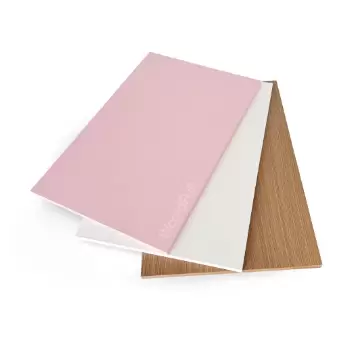
The performance foundation of Melamine Plywood is determined by its core board structure. High-grade plywood substrates typically maintain a density range between 520–680 kg/m³, depending on application requirements.
Uniform density distribution is critical because it directly affects:
Screw holding strength
Machining edge stability
Warp resistance under humidity changes
When density variation exceeds ±5%, panel deformation risk increases significantly during cutting and edge banding processes.
The melamine impregnated decorative layer is not only a visual element but also a functional protective barrier. Industrial-grade Melamine Plywood typically uses resin-impregnated decorative paper with controlled resin content between 120–180 g/m².
This surface layer provides:
Scratch resistance above 2H pencil hardness
Chemical resistance against common household solvents
UV stability for long-term color retention
In furniture systems exposed to frequent cleaning or sunlight, surface resin uniformity becomes a key factor in long-term aesthetic durability.
The hot pressing process defines the structural integrity between melamine film and plywood substrate. Standard industrial pressing conditions range between 180°C and 210°C with pressures of 20–35 kg/cm² depending on board thickness.
Inconsistent pressing parameters often lead to:
Surface bubbling
Delamination under humidity stress
Uneven gloss distribution
Modern production systems focus on multi-stage pressure control to ensure uniform resin curing and minimize internal stress accumulation.
One of the most critical performance indicators of Melamine Plywood is its reaction to humidity variation. In real-world applications such as kitchen cabinets, bathroom furniture, and commercial interiors, boards are frequently exposed to RH levels between 40% and 85%.
High-quality Melamine Plywood typically maintains thickness swelling below 8% after 24-hour water immersion testing, ensuring dimensional stability during seasonal humidity fluctuations.
This stability is essential for maintaining tight assembly tolerances in modular furniture systems.
Melamine Plywood is widely used in:
Kitchen cabinet structures requiring moisture resistance and easy cleaning
Office furniture systems demanding high scratch resistance and durability
Retail display units requiring consistent decorative surface appearance
Residential interior paneling systems requiring low emission and stable geometry
In these applications, performance consistency directly impacts installation efficiency and long-term maintenance cost.
A major evolution in the Melamine Plywood industry is the shift toward environmentally safe adhesive systems. New-generation boards increasingly adopt zero-formaldehyde or ultra-low emission bonding technologies.
In advanced material systems developed by manufacturers such as Shandong Xingang Group, bio-based adhesive technologies are used to achieve zero formaldehyde, zero benzene, and zero harmful substances emission levels. This enables Melamine Plywood to meet increasingly strict indoor air quality standards while maintaining structural strength and processing performance.
Melamine Plywood performance is not defined by a single parameter but by the interaction between substrate stability, resin quality, pressing technology, and environmental resistance.
In industrial furniture manufacturing, consistent performance across these parameters determines production efficiency, product lifespan, and end-user satisfaction. As demand for sustainable and high-performance materials continues to rise, engineered Melamine Plywood systems are becoming the standard foundation for modern interior applications.