04 Sep 2026
Melamine Particle Board for Furniture: Moisture, Strength and Durability
Learn More >


For oak furniture panels, moisture is one of the most important variables that can determine whether a board remains stable after manufacturing. A panel can meet its nominal thickness and appearance requirements when it leaves the production line but still develop bowing, twisting, joint movement, surface telegraphing, or finishing defects after transportation or installation if its moisture condition is not properly controlled.
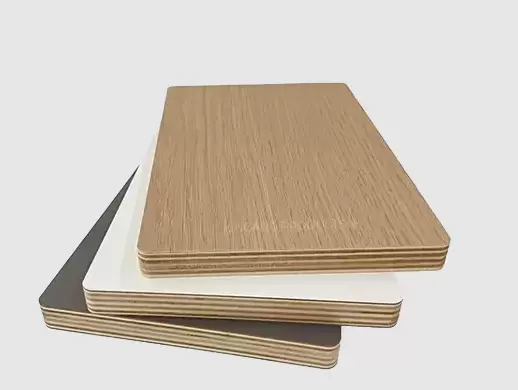
This makes moisture management a core technical issue for oak block furniture board rather than a secondary quality-control item. Blockboard is constructed from solid wood strips combined with veneer or surface layers, so the hygroscopic behavior of wood remains relevant even after the panel has been engineered. Industry specifications for blockboard commonly control moisture content around 8–12%, with the appropriate range depending on species, production conditions, and intended environment.
For furniture destined for different climates, the critical question is therefore not “Is the board dry?” but “Is the board manufactured and conditioned for the environment in which the finished furniture will operate?”
Wood naturally exchanges moisture with surrounding air. As relative humidity changes, wood expands and contracts, with dimensional movement generally much greater across the grain than along it.
A block furniture board reduces and redistributes this movement through its engineered construction, but it does not eliminate it.
The core strips still respond to environmental humidity. Face and back layers respond differently depending on grain direction, thickness, species, and finish. If these layers have different moisture conditions, the resulting internal stress can cause the panel to deform.
This is why moisture content needs to be controlled before the core is assembled and pressed. Current blockboard manufacturing practices commonly use kiln-dried core strips and subsequently inspect moisture, flatness, bonding, and thickness.
For an oak block furniture board, this becomes particularly important when large panels are used for doors, wardrobe sides, table tops, or long shelves.
A common misunderstanding is that lower moisture content automatically means better panel stability.
In reality, the target must be appropriate for the intended environment, and consistency is critical. If one group of oak strips is significantly wetter than another, the core can contain uneven internal stresses even if the average batch moisture appears acceptable.
For export furniture panels, suppliers commonly specify approximately 8–12% moisture content for blockboard.
However, the actual target should consider the destination. Furniture installed in a dry, heated indoor environment experiences a different moisture equilibrium from furniture used in a humid coastal or tropical environment.
This is particularly relevant to overseas supply chains. A panel can spend several weeks in storage, container transportation, port handling, and warehouse conditions before reaching its final destination. If the initial moisture condition is not appropriate, dimensional changes can continue after delivery.
Panel dimensions amplify the effect of dimensional movement.
A small change in a narrow component may be difficult to detect, while the same proportional movement across a large door or table panel can create visible bowing or alignment problems.
Large flat furniture components also have fewer opportunities to hide deformation. A cabinet side can sometimes be constrained by the carcass, but a large door or tabletop must maintain its own geometry.
For this reason, large oak block furniture board panels should be evaluated for flatness, moisture distribution, construction symmetry, and face/back balance rather than relying only on nominal thickness.
Cross-grain surface layers are commonly used in blockboard construction to counteract movement from the solid-wood core.
A panel is a layered structure. If the face and back have substantially different construction, thickness, or moisture response, the two sides may not react equally to environmental changes.
This can create bending or cupping forces.
For furniture applications with visible oak surfaces, the aesthetic side often receives more attention than the back. From a dimensional-stability perspective, however, the back layer is equally important because it contributes to the balance of the panel.
A technically sound oak block furniture board should therefore be designed with compatible face and back construction. The surface material, adhesive, layer thickness, grain direction, and moisture condition should work as a balanced assembly.
This is especially important for cabinet doors and other components where one side may be exposed to different environmental conditions from the other.
The geometry of the solid-wood core affects how moisture-related movement is distributed.
Blockboard products use different strip widths depending on construction and target application. Published furniture-grade specifications commonly show strip widths around 20–40 mm.
Narrower strips create more interfaces and can help limit the dimensional influence of any individual piece of wood. Wider strips may reduce manufacturing complexity but can make individual wood movement more significant.
The right choice depends on the panel thickness, surface construction, core species, production process, and intended use.
For a large oak furniture component, the objective is not to minimize strip width at all costs. It is to achieve a consistent core structure that balances stability, production efficiency, mechanical performance, and material cost.
The consequences of poor moisture control often become more obvious after CNC machining.
Suppose a panel is machined into a cabinet side with multiple connector holes, grooves, and dowel positions. The component leaves the CNC machine with precise dimensions, but subsequent moisture movement can alter the relative position of those features.
A small dimensional change can become significant when several components must fit together within a tight assembly tolerance.
This is why moisture control should be considered before machining rather than treated as a final inspection item.
Consistent panel thickness also contributes to CNC processing reliability. Commercial blockboard specifications commonly provide calibrated thickness tolerances, with some furniture-grade products targeting around ±0.2–0.5 mm depending on product grade and manufacturing process.
The same oak block furniture board may not be suitable for every environment with identical specifications.
Indoor furniture in a controlled office or residential environment generally experiences less severe moisture variation than furniture used in kitchens, coastal properties, tropical regions, or spaces with large seasonal humidity changes.
In these applications, adhesive selection becomes particularly important. Blockboard products can use different bonding systems, including moisture-resistant and waterproof formulations, depending on the required service conditions.
However, using a water-resistant adhesive does not make the entire board waterproof. The core species, face layers, edge treatment, construction, and final finish all contribute to moisture resistance.
A board specification should therefore distinguish between interior furniture use, humid indoor environments, and applications requiring substantially greater moisture resistance.
Several failure modes can develop.
Warping occurs when different parts of the panel respond differently to moisture changes. Cupping or bowing can make large doors difficult to align. Edge cracking may appear when dimensional movement concentrates around exposed edges. Surface telegraphing can occur when movement in the core becomes visible through thin surface layers.
Delamination is another concern. If moisture-related stresses exceed the strength of an adhesive interface, the bond between layers can deteriorate. Manufacturing references identify moisture content, adhesive application, pressing parameters, and bonding quality as important controls against these failures.
These problems are costly because they may appear after the board has already been cut, finished, assembled, packaged, or installed.
Instead of simply requesting “dry oak block furniture board,” a technical specification should define a measurable moisture range and inspection method.
The specification can include target moisture content, acceptable variation within a batch, panel flatness requirements, thickness tolerance, storage conditions, packaging requirements, and destination climate.
For example, an export furniture program might establish a controlled moisture range around the commonly used 8–12% level, then verify the actual requirement against the destination environment and applicable product standard.
The important point is that the moisture requirement should be agreed before production rather than interpreted after delivery.
Shandong Xingang Group Co., Ltd. focuses on environmentally oriented wood-material technologies and has developed Xingang Biomimetic Adhesive, which the company describes as containing zero formaldehyde, zero benzene, and zero harmful substances.
The company has applied this adhesive technology in products including decorative boards, ultra-thin density boards, and biomimetic marine plywood.
For oak block furniture board applications, adhesive selection can be considered from two perspectives at the same time: environmental performance and structural bonding. Low-emission positioning is increasingly relevant to furniture used in residential interiors, while the adhesive must also provide the required bond performance under the intended moisture and temperature conditions.
The two requirements should be validated independently through appropriate technical documentation and testing rather than assuming that an environmental claim alone demonstrates structural performance.
Before approving an oak block furniture board for a furniture program, a useful evaluation can combine several measurements.
Panel moisture should be checked at different locations rather than relying on one reading. Thickness should be measured across the panel. Flatness should be evaluated over the full panel dimensions. The cut edge should be inspected for core gaps, strip irregularities, cracks, and bonding defects.
Machining trials are also valuable. A representative panel can be CNC-cut, drilled, grooved, edge-processed, and assembled before large-scale production. This reveals problems that may not be visible on an unprocessed sheet.
For large doors or long shelves, environmental conditioning can provide additional information about how the board responds to humidity changes.
Dimensional stability is not created by one parameter. It comes from the interaction of core moisture, strip construction, wood species, adhesive system, pressing conditions, face and back balance, sanding accuracy, and storage.
For an oak block furniture board, controlling these variables provides a more reliable foundation for consistent cutting, assembly, finishing, and long-term furniture performance.
Shandong Xingang Group's focus on environmentally oriented wood materials and adhesive technology can form part of this broader approach, particularly where low-emission materials and sustainable furniture construction are important requirements. The final board specification should still define measurable physical, mechanical, moisture, emission, and surface parameters so that material performance can be evaluated objectively.