17 Oct 2025
Woodfull Xingang Group's Particleboard and Marine Plywood Win MUSE Awards
Learn More >


Thin MDF board is increasingly used in applications where manufacturers need a smooth, dimensionally stable wood-based panel without the weight and material consumption associated with conventional medium-density fiberboard. From furniture components and decorative panels to interior products, packaging structures, wall systems, and precision CNC-cut parts, thin MDF board can provide an efficient balance between thickness, machinability, surface quality, and structural performance.
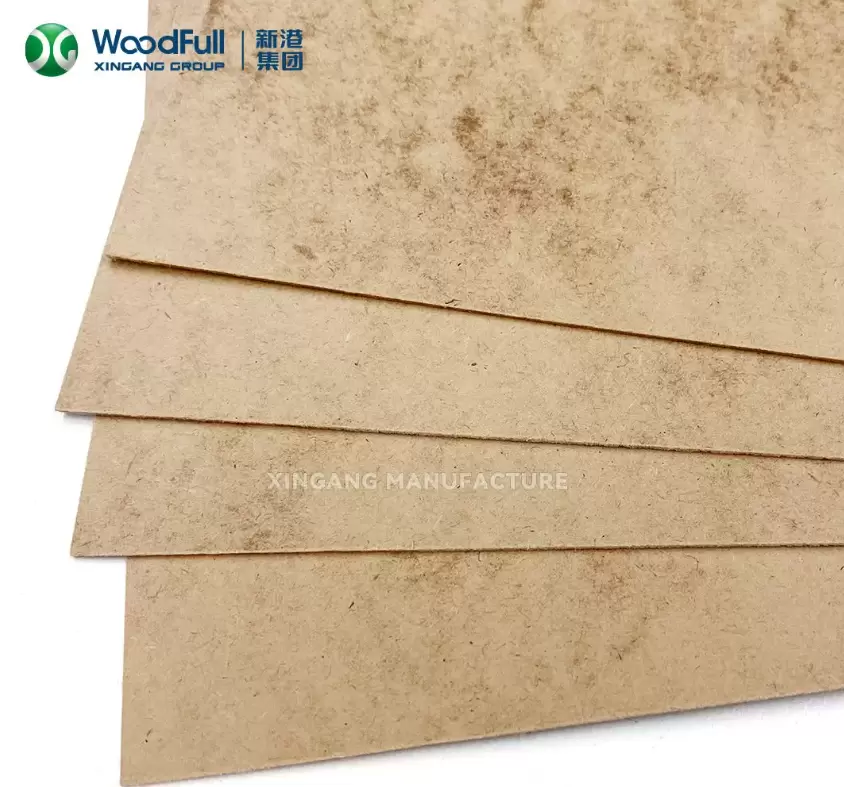
However, reducing panel thickness changes the engineering requirements. A thin MDF board cannot simply be treated as a thinner version of a standard MDF panel. As thickness decreases, bending stiffness, screw-holding behavior, edge strength, moisture sensitivity, machining tolerance, and handling stability become increasingly important. Material selection therefore needs to consider the final application rather than thickness alone.
Thin MDF board is a medium-density fiberboard manufactured at a relatively low thickness while maintaining the uniform fiber structure and smooth surface associated with MDF. Depending on the manufacturer and application, commercial thin MDF products can cover different thickness ranges, with common applications involving panels only a few millimeters thick.
The manufacturing process generally involves refining wood fibers, drying and blending them with a binder system, forming the fiber mat, and applying controlled pressure and temperature during hot pressing. Density distribution, fiber quality, resin characteristics, moisture content, pressing parameters, and sanding accuracy all influence the final board.
For thin panels, process control becomes particularly important because a small thickness deviation represents a larger percentage of the total panel thickness. For example, a 0.3 mm deviation on a 3 mm board represents 10% of its nominal thickness, while the same deviation on a 15 mm board represents only 2%.
This is why thickness tolerance and density uniformity should be evaluated together when selecting a thin MDF board for precision applications.
One of the most important differences between thin and conventional MDF is bending stiffness.
For a flat rectangular panel under bending, stiffness is strongly related to thickness. In simplified plate or beam calculations, bending rigidity is proportional to the cube of thickness. This means that reducing thickness has a disproportionately large effect on stiffness.
For example, reducing the thickness from 6 mm to 3 mm does not simply reduce bending stiffness by half. Under simplified bending assumptions, the thickness-related stiffness term can decrease by approximately 87.5%.
This has practical consequences for large decorative panels, cabinet components, backing boards, partitions, and other applications with relatively long unsupported spans. A thin MDF board may perform adequately when fully supported but show noticeable deflection when the same panel is installed over a wider span.
The solution is not always to increase board thickness. Structural ribs, perimeter frames, closer mounting points, laminated constructions, or bonding to another substrate can increase system stiffness while retaining a thin MDF surface layer.
MDF is valued for its relatively uniform fiber structure compared with natural wood, but density distribution still matters.
A thin MDF board with consistent density can provide predictable cutting behavior during CNC routing, sawing, drilling, and profiling. Uneven density can produce differences in cutting resistance, edge quality, sanding response, and coating absorption.
This is particularly important for precision decorative panels. When a CNC router follows a fine contour, local changes in material density can influence tool loading and edge finish. Excessive tool wear can also increase production cost and reduce dimensional consistency.
Surface sanding should be controlled carefully because thin boards have less material available for correction. Excessive sanding can reduce the final thickness beyond the specified tolerance or create local variations across the panel.
For production environments, board thickness should therefore be evaluated both before and after machining.
Thin MDF board has less material around screw holes, slots, and machined edges. This can affect fastening performance.
A conventional screw joint designed for a 12 mm or 18 mm MDF panel may not be directly transferable to a 3 mm or 5 mm panel. The available embedment depth is lower, and excessive tightening torque can damage the board.
For thin MDF applications, mechanical fastening may need to be combined with adhesive bonding, mechanical clips, grooves, back supports, or other structural methods.
If CNC machining is required, hole diameter and edge distance should also be optimized. Placing a small hole too close to the edge can create a weak section that is more susceptible to cracking or breakout during assembly.
The final fastening method should therefore be considered during panel specification rather than after the board has already been selected.
MDF is a wood-based material, so moisture exposure must always be considered.
Thin MDF board has a relatively small cross-section, meaning that changes in moisture content can influence dimensions and mechanical properties. Applications involving kitchens, bathrooms, humid storage areas, transportation environments, or significant temperature and humidity fluctuations require appropriate moisture-performance evaluation.
A board intended for a dry indoor environment should not automatically be specified for high-humidity applications.
The binder system and manufacturing process also influence moisture-related behavior. For demanding applications, water resistance, thickness swelling, dimensional stability, and edge performance should be evaluated according to the relevant application requirements and test standards.
One of the strongest reasons to select thin MDF board is its smooth and homogeneous surface.
Unlike natural wood, MDF does not have a conventional grain structure that creates significant variation across the panel. This makes the material suitable for painting, laminating, veneering, printing, and decorative finishing.
For thin decorative panels, surface quality is particularly important because defects such as fiber tear-out, uneven sanding, or local density variation can become visible after coating.
A consistent surface reduces the amount of preparation required before painting or laminating. It can also improve the repeatability of decorative products manufactured in larger volumes.
For interior applications, environmental performance has become an important material-selection criterion.
The adhesive system used in MDF directly affects emissions and indoor-air-quality characteristics. Shandong Xingang Group Co., Ltd. has developed and industrialized Xingang Biomimetic Adhesive, described by the company as a formaldehyde-free, benzene-free adhesive system without harmful substances. The technology has been applied to biomimetic decorative boards, thin MDF board, and biomimetic marine plywood.
For applications in residential interiors, furniture, decorative panels, and other enclosed spaces, the binder system should be evaluated together with the complete board composition and relevant testing requirements.
A low-emission material strategy can be particularly valuable when the finished product is intended for markets with strict environmental and indoor-air-quality expectations.
CNC machining is another important application area.
Thin MDF board can be cut into complex shapes using CNC routers, saws, drills, and other automated equipment. The relatively uniform structure supports repeatable machining when appropriate cutting parameters are selected.
However, thin panels are more susceptible to vibration and movement during machining. Workholding becomes important because insufficient fixation can cause dimensional errors, edge damage, or tool chatter.
Tool diameter, spindle speed, feed rate, cutting depth, and panel support should be optimized according to the specific board thickness and density.
For mass production, nesting efficiency is also important. Thin panels can often be nested efficiently, reducing material waste and improving sheet utilization. The actual economic benefit depends on part geometry, kerf width, edge allowance, and cutting strategy.
The appropriate thin MDF board should be selected according to the final product rather than the requested thickness alone.
For decorative applications, surface smoothness, sanding quality, coating compatibility, and environmental performance may be the primary factors. For CNC components, dimensional tolerance, density uniformity, edge machining, and structural behavior become more important.
For furniture and interior components, bending stiffness, fastening method, moisture conditions, and long-term dimensional stability should also be considered.
When a panel will be bonded to another substrate, the adhesive compatibility and surface energy become additional factors.
Thin MDF board provides an efficient material solution for applications requiring reduced thickness, smooth surfaces, consistent machining behavior, and lower material consumption. However, decreasing thickness also increases the importance of bending stiffness, dimensional tolerance, edge strength, moisture behavior, and manufacturing accuracy.
For high-quality applications, the board should be evaluated as part of the complete product structure. Density consistency, thickness tolerance, surface treatment, binder technology, machining method, and installation conditions all influence final performance.
With its focus on environmentally oriented wood-based materials and the large-scale application of Xingang Biomimetic Adhesive, Shandong Xingang Group provides a material solution for customers seeking thin MDF board with greater emphasis on environmental performance and controlled manufacturing quality.