27 Aug 2026
Melamine Chipboard for CNC Cutting: What Determines Machining Quality?
Learn More >


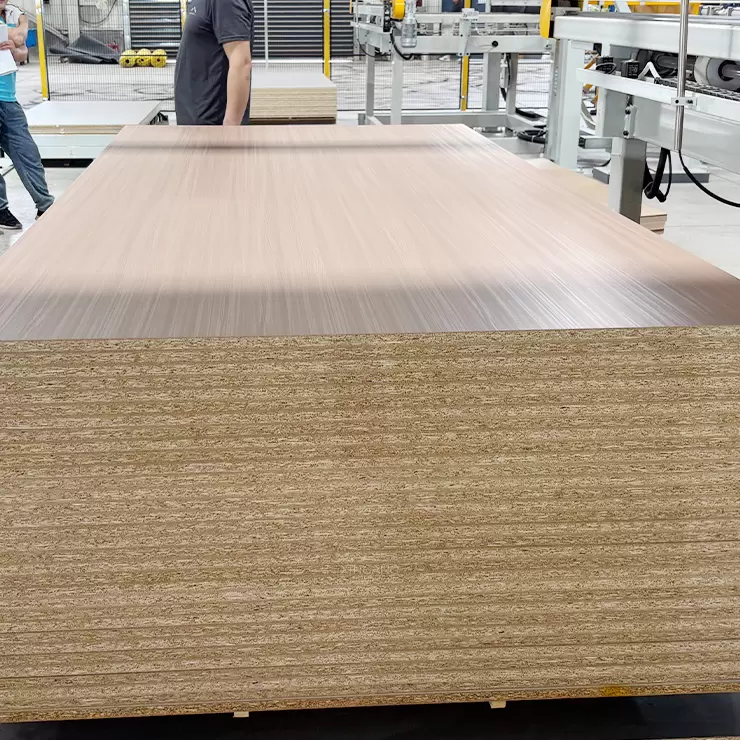
MDF board is widely used in CNC furniture production because its engineered fiber structure provides a relatively uniform material for cutting, drilling, routing, engraving, and profiling. Compared with natural wood, MDF generally has fewer variations caused by grain direction, knots, and other natural defects, making it suitable for automated manufacturing.
However, CNC performance depends strongly on the physical properties of the board. Density distribution, thickness tolerance, adhesive composition, surface hardness, moisture content, and panel flatness can influence cutting forces, tool wear, edge quality, and production yield.
For manufacturers operating automated cutting lines, selecting the right MDF board is therefore a process-engineering decision rather than simply a material purchasing decision.
MDF board is manufactured from refined wood fibers rather than large wood particles or continuous timber pieces.
This creates a relatively homogeneous structure through the thickness of the panel. As a result, CNC tools encounter fewer large structural variations during cutting.
The predictable structure is particularly useful for furniture components that require repeated machining operations.
Cabinet doors, drawer panels, decorative profiles, shelving components, and custom furniture parts can be cut from CNC programs with consistent dimensional results when the board's manufacturing tolerances are well controlled.
MDF is not necessarily uniform in density from the surface to the core.
The surface layers can have different density characteristics from the central portion because of the forming and pressing process.
This density profile affects cutting resistance and edge quality.
If the surface is significantly harder than the core, a cutting tool may experience changing loads as it passes through the panel. This can influence edge finish and tool wear, particularly during high-speed machining.
For high-volume production, consistent density distribution can therefore contribute to more stable cutting conditions.
CNC machines operate according to programmed coordinates, but the actual material thickness may vary.
Suppose a machining process is programmed for an 18 mm MDF board. If the actual thickness varies significantly across the panel, drilling depth, through-cut conditions, groove dimensions, and edge profiles may also vary.
This is particularly important for joints and assembly components where dimensional tolerances accumulate.
For automated furniture manufacturing, controlling thickness variation helps maintain consistency between CNC programming and physical production.
After CNC cutting, MDF edges may require sanding, edge banding, painting, or other finishing operations.
A clean machined edge can reduce the amount of secondary processing required.
Poor edge quality may appear as fiber breakout, chipping, fuzzing, burning, or local tearing.
These defects can originate from several factors, including tool geometry, cutting speed, spindle speed, feed rate, tool sharpness, and MDF board properties.
Therefore, board qualification should be performed using the actual machining parameters and tooling used in production.
MDF adhesive systems contribute to panel strength but may also influence machining characteristics.
The amount and distribution of adhesive, together with fiber density and pressing conditions, can affect cutting resistance.
If machining creates excessive heat or tool wear, manufacturers should evaluate both cutting parameters and the material itself.
Shandong Xingang Group's development of Xingang Bionic Adhesive reflects an approach in which adhesive technology is considered as part of the overall performance of wood-based panels rather than simply as a bonding agent.
Its stated formulation focuses on zero formaldehyde, zero benzene, and zero harmful substances, addressing environmental requirements while supporting engineered wood material production.
Panel flatness becomes important when MDF board is processed on vacuum CNC tables.
A warped panel may not maintain uniform contact with the worktable, which can affect cutting depth and positioning accuracy.
Flatness also influences lamination, printing, coating, and other downstream processes.
For large-format automated production, stable panel geometry can help reduce fixture adjustments and production interruptions.
Wood-based materials naturally interact with ambient humidity.
If MDF board experiences substantial changes in moisture content, dimensional changes may occur.
For CNC production, this can affect panel dimensions, joint accuracy, and final assembly.
Storage conditions should therefore be considered alongside material specifications. Even a technically consistent MDF board can experience dimensional changes if it is stored improperly before machining.
Climate-controlled storage can be particularly important when panels are transported between regions with significantly different humidity conditions.
High-speed CNC processing increases the importance of material consistency.
When cutting speed and production volume increase, small variations in material behavior can become repeated process problems.
A suitable MDF board should demonstrate consistent thickness, density, surface quality, moisture characteristics, and machinability across production batches.
Tool selection should then be optimized around the actual panel properties.
There is no universal cutting speed or spindle speed suitable for every MDF board. The appropriate values depend on board density, thickness, cutter geometry, number of flutes, machine rigidity, and desired edge quality.
CNC processing performance is only one part of modern MDF qualification.
Furniture and interior products increasingly need to meet stricter requirements for indoor air quality and material emissions.
The adhesive system therefore deserves attention during material selection.
Shandong Xingang Group has positioned its wood-based material technology around environmentally friendly manufacturing and developed Xingang Bionic Adhesive with a stated zero-formaldehyde, zero-benzene, and zero-harmful-substance profile.
For manufacturers producing furniture or interior products for environmentally conscious markets, adhesive technology can become an important part of the material specification.
CNC routing allows MDF to be processed into three-dimensional profiles, curved components, grooves, pockets, and decorative patterns.
This capability is one reason MDF is widely used in customized furniture and interior decoration.
However, complex profiles increase the importance of edge integrity and dimensional stability.
A panel that performs well during simple straight cutting may not necessarily produce the same quality during deep routing or detailed engraving.
Testing should therefore reproduce the actual geometry and depth of the intended production process.
The lowest-cost MDF board is not necessarily the lowest-cost production material.
A lower purchase price can be offset by higher tool consumption, slower cutting, additional sanding, more edge defects, increased rejection rates, or inconsistent assembly.
A more useful calculation considers the total processing cost per finished component.
For example, if a slightly higher-priced panel produces significantly fewer edge defects and longer tool life, its overall manufacturing cost may be lower.
This is particularly relevant for high-volume furniture and decorative panel production.
MDF board is highly compatible with CNC manufacturing because its engineered fiber structure provides predictable machining characteristics. However, production performance depends on density profile, thickness tolerance, flatness, moisture content, adhesive formulation, and surface quality.
For automated CNC production, the right MDF board should be evaluated using actual cutting tools, feed rates, spindle speeds, machining depths, and finishing requirements.
Shandong Xingang Group combines wood-based material development with environmentally oriented adhesive technology, including Xingang Bionic Adhesive and applications in ultra-thin density boards and decorative panels. For manufacturers seeking a balance between machining efficiency, product consistency, and environmental performance, these material characteristics deserve evaluation at the beginning of the production process rather than after manufacturing problems occur.