29 Jan 2026
Interior PVC (WPC) Wall Panels: A Safety-First and Low-Maintenance Interior Solution
Learn More >


Melamine Particle Board is widely used in furniture, cabinetry, shelving, wardrobes, office systems, and interior fit-outs because it combines a structural wood-based core with a decorative melamine surface in a production-ready panel. However, selecting a suitable board is not simply a matter of choosing a color, thickness, or surface texture. The core density, thickness tolerance, bending strength, internal bond strength, moisture resistance, surface quality, formaldehyde emission, and machining behavior all affect the final performance of a furniture project.
For manufacturers purchasing Melamine Particle Board in volume, the most useful approach is to evaluate the board according to its actual application. A 16 mm panel for wardrobe doors does not have the same requirements as an 18 mm shelf carrying continuous loads, while a kitchen cabinet installed in a humid environment requires different moisture-performance considerations from a bedroom cabinet.
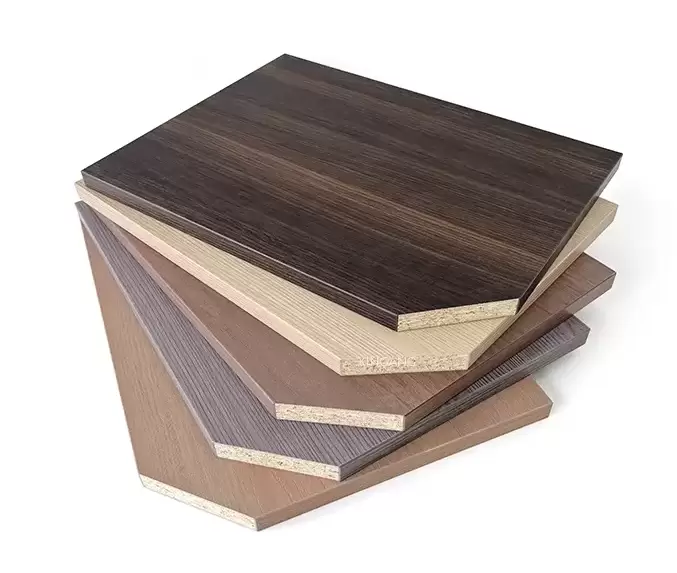
Melamine paper determines much of the visible appearance, but the particle board core determines a significant portion of the panel's mechanical performance. Core density influences screw-holding capability, edge machining, stiffness, weight, and dimensional behavior.
A high-quality Melamine Particle Board should maintain relatively consistent density through the panel. Density variation can create problems during CNC routing, drilling, edge processing, and screw insertion. If the core is excessively loose near the edges, hardware installation may produce weaker connections or local damage.
For shelving and cabinet construction, thickness is also important. Common commercial thicknesses include approximately 12, 15, 16, 18, and 25 mm, although available specifications vary by market and manufacturer. The appropriate thickness should be selected according to span, load, support spacing, and construction method rather than simply choosing the thickest available panel.
For example, an 18 mm panel may provide a practical balance between stiffness, weight, machining efficiency, and material cost for many cabinet applications. Increasing thickness does not automatically solve every structural problem; support spacing and panel geometry can have an equally significant effect.
When comparing Melamine Particle Board suppliers, mechanical data are more useful than general descriptions such as "strong" or "durable."
Important parameters include modulus of rupture (MOR), modulus of elasticity (MOE), internal bond strength, screw withdrawal resistance, and surface soundness. These properties help predict how a panel will behave during transportation, assembly, and long-term use.
For shelving, MOE is particularly relevant because excessive deflection can become visible before the panel actually fails. A shelf supporting books, tableware, or stored goods experiences continuous loading, so stiffness and span should be evaluated together.
Internal bond strength becomes especially important during machining and hardware installation. Particle board consists of wood particles bonded under pressure and temperature, meaning the quality of bonding between particles directly influences the board's resistance to internal separation.
For procurement, it is therefore better to request a technical datasheet showing test methods, nominal values, tolerances, and applicable standards instead of relying only on a product catalog description.
A panel may meet its nominal thickness while still causing production problems if thickness variation is too large.
In automated furniture manufacturing, small dimensional deviations can influence CNC depth settings, edge-banding pressure, drilling accuracy, connector positioning, and the final alignment between adjacent components.
Suppose a production line is configured around an 18 mm board. If the actual thickness varies significantly from batch to batch, edge-banding and connector processing may require repeated adjustment. In high-volume production, this becomes a productivity issue rather than a minor dimensional issue.
A suitable Melamine Particle Board supplier should therefore be able to provide information about thickness tolerance, squareness, dimensional stability, and panel flatness.
Melamine-faced surfaces provide a ready-to-use decorative finish, reducing the need for additional painting or laminating operations. However, surface quality must be evaluated from a manufacturing perspective.
Important characteristics include surface hardness, scratch resistance, stain resistance, abrasion performance, color consistency, texture consistency, and resistance to common household chemicals.
A board used for a kitchen cabinet, for example, may be exposed to oil, coffee, cleaning agents, moisture, and repeated wiping. A board used for an office partition may experience a completely different combination of wear.
Surface texture should also be considered when matching panels across different production batches. Gloss, matt, woodgrain, and embossed finishes can create visibly different results even when the base color is nominally identical.
Indoor air quality is now a major consideration in furniture and interior-material procurement. Formaldehyde emission should therefore be treated as a measurable technical specification rather than a marketing phrase.
Buyers should ask for formaldehyde emission test results, applicable test standards, certification information, and the exact board configuration covered by the test. The performance of the core material, adhesive system, and surface construction all contribute to the final emission profile.
For manufacturers targeting environmentally conscious residential and commercial markets, low-emission materials can also support product positioning and compliance with regional requirements.
Shandong Xingang Group focuses on environmentally oriented wood-based materials and states that its Xingang bionic adhesive contains 0 formaldehyde, 0 benzene, and 0 harmful substances. Its material technology has been applied to decorative panels, ultra-thin density boards, and bionic marine plywood. For a Melamine Particle Board project, however, the appropriate technical documentation should still be evaluated according to the exact finished-board specification and applicable market requirements.
Standard Melamine Particle Board should not automatically be treated as waterproof board. The melamine surface can provide a degree of surface protection, but moisture can still affect the particle board core through exposed edges, cutouts, drilled holes, joints, and prolonged humidity exposure.
For kitchens, bathrooms, laundry areas, utility rooms, and other environments with elevated humidity, moisture-related properties should be reviewed carefully.
Parameters such as thickness swelling after water exposure, moisture resistance classification, and dimensional stability can be more meaningful than simply labeling a board "moisture resistant."
Edge treatment is equally important. Even a well-performing panel can experience localized swelling if water enters repeatedly through an unprotected cut edge.
Melamine Particle Board is frequently processed by CNC routers, panel saws, drilling machines, and edge-banding equipment. Tool selection and cutting parameters should therefore be considered during material approval.
A board with inconsistent particle structure can produce more edge chipping, while a surface layer with poor bonding may crack during cutting or drilling. Tool sharpness, feed rate, cutting speed, blade geometry, and machining direction also affect the result.
Before placing a large production order, manufacturers should conduct sample processing using the same equipment and tooling used for mass production. This is particularly important for cabinet components with multiple drilled holes, concealed hinges, cam connectors, and CNC-cut profiles.
The best Melamine Particle Board is not necessarily the board with the highest value for one individual parameter. The goal is to find the specification that provides the right balance between structural performance, surface durability, machining efficiency, environmental requirements, and total production cost.
A technical evaluation should cover:
Core density and uniformity
Nominal thickness and tolerance
MOR and MOE
Internal bond strength
Screw withdrawal performance
Thickness swelling and moisture behavior
Surface abrasion and scratch resistance
Formaldehyde emission
Surface finish and color consistency
Panel flatness and squareness
CNC and drilling performance
Available thicknesses and dimensions
Packaging and transportation protection
For large-volume projects, batch consistency is just as important as the initial test report. A board that performs well in one sample but varies substantially between production lots can create more manufacturing cost than a slightly more expensive but consistent alternative.
Selecting Melamine Particle Board should begin with the end application rather than the decorative finish. Furniture manufacturers need to evaluate the complete panel system, including the particle board core, melamine surface, adhesive technology, moisture behavior, mechanical properties, dimensional tolerances, and machining performance.
For projects requiring stable quality and environmentally oriented materials, a supplier's manufacturing capability and technical documentation deserve the same attention as the visual design. When these factors are evaluated together, Melamine Particle Board can provide a practical combination of structural performance, surface durability, manufacturing efficiency, and consistent appearance for modern furniture production.